
Introduction
GLP-1 receptor agonists are arguably the most significant advance in obesity medicine in a generation. Retatrutide, semaglutide (Ozempic/Wegovy), tirzepatide (Mounjaro) — the results people are seeing are real. But the medical community, and most gyms, are completely silent on the single biggest risk hiding inside every success story: catastrophic muscle and bone loss.
GLP-1s Don’t Care What They Shrink
These medications work by suppressing appetite dramatically. You eat less. You lose weight. Simple, right? Not quite. When your body is in a severe calorie deficit — which is what GLP-1s engineer — it doesn’t just burn fat. It burns everything available for fuel.
And muscle is expensive to maintain. Your body treats it as a resource, not an asset. Without a direct signal telling your body to keep that muscle, it will happily discard it alongside the fat.
The numbers that should alarm you:
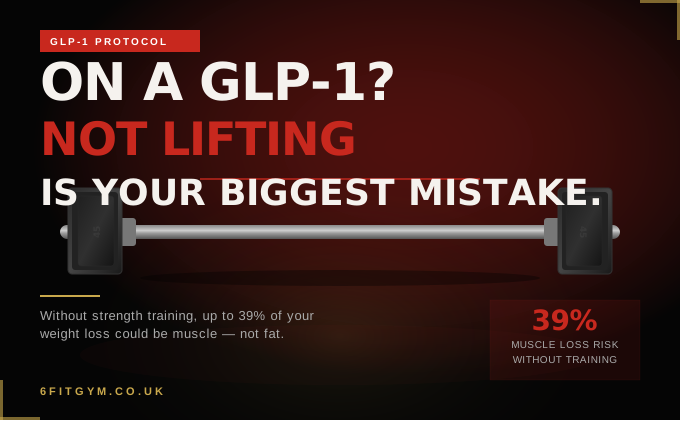
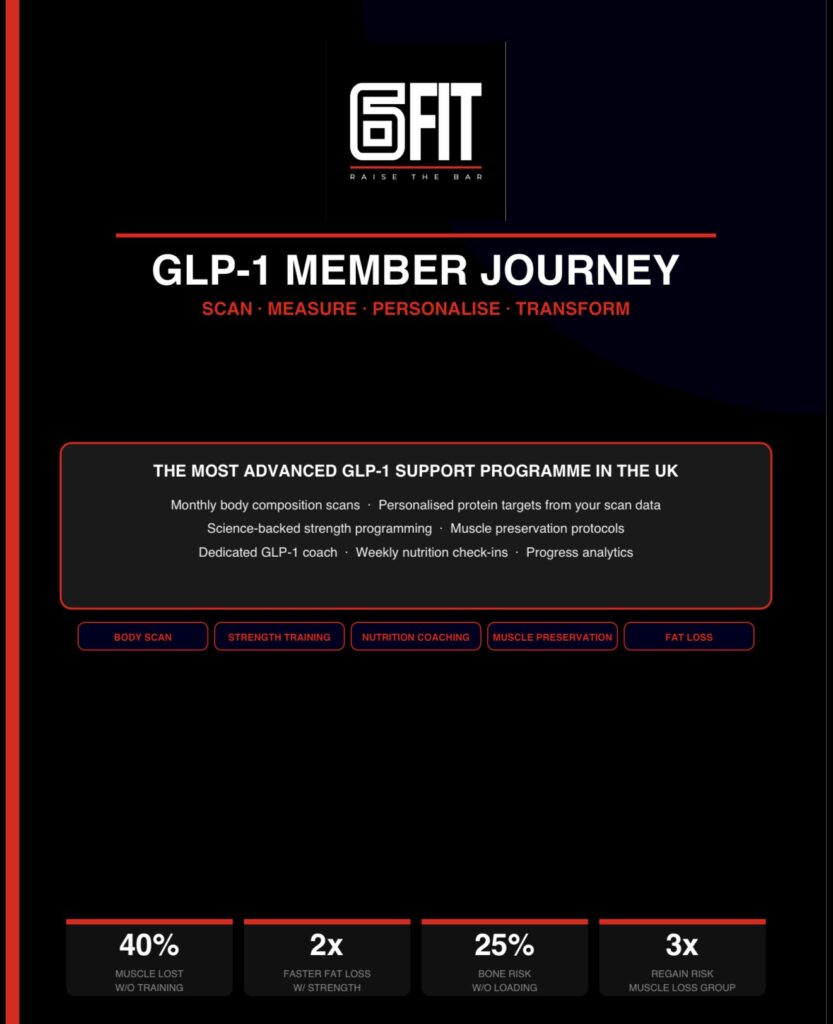
- 25–39% of weight lost on GLP-1s can be lean muscle mass
- 3–5% average bone density reduction in GLP-1 trials over 12–18 months
- 2× greater fat regain risk when muscle is lost during weight loss
Let that sink in. In some clinical scenarios, nearly 40% of the weight you lose on a GLP-1 could be muscle. Not fat. Muscle. The metabolically active tissue that keeps you strong, insulin-sensitive, and protected against rebound weight gain.
⚠️ THE REBOUND NOBODY TALKS ABOUT
When people stop GLP-1 medication — or even reduce their dose — without having built muscle, the weight comes back fast. And it comes back predominantly as fat, because the muscle that would have burned it is gone. This is how people end up worse off than when they started.
The Biology You Need to Understand
Muscle protein synthesis drops with calorie restriction
When you’re eating less — dramatically less, as GLP-1s often cause — your body’s ability to synthesise new muscle protein falls. Unless you actively stimulate muscle via resistance training, the balance tips toward muscle breakdown (catabolism) rather than maintenance or growth.
GLP-1 receptors exist in skeletal muscle
Recent research has identified GLP-1 receptors in muscle tissue itself. While this is an evolving area of science, the evidence suggests these medications may directly influence muscle metabolism — another reason why the exercise stimulus matters more, not less, when you’re on these drugs.
Bone density follows muscle load
Your skeleton adapts to the forces placed on it. When you carry excess weight and then lose it rapidly — without replacing that mechanical load with resistance training — bone density drops. This increases your fracture risk and accelerates age-related bone loss. Strength training is the most effective non-pharmacological intervention known to protect and build bone density.
“The goal is not simply to weigh less. The goal is to be genuinely healthier — stronger, leaner, more functional, and more metabolically resilient. A GLP-1 without a strength protocol is half a solution.”
Lift Heavy. Eat Protein. No Exceptions.
There are two things that, without question, the scientific literature agrees on for anyone on a GLP-1 medication:
01 — Resistance Training Minimum 3× per week. Compound movements. Progressive overload. This is the direct signal that tells your body: keep the muscle. Without it, no amount of protein will fully compensate.
02 — Protein Intake 1.6–2.2g per kg of bodyweight daily. This is significantly higher than typical recommendations — because your appetite suppression means you have to deliberately prioritise protein at every meal.
03 — Calorie Floor Eating too little is dangerous on GLP-1s. Most people need a minimum of 1,400–1,600 kcal to maintain organ function and muscle protein synthesis. Lower than this accelerates muscle loss rapidly.
04 — Consistency Over Intensity GLP-1 journeys are 12–24 months for most people. You need a training system built for the long game — not a crash programme that burns you out in 6 weeks.
Why protein feels harder on GLP-1s — and what to do
The nausea and appetite suppression that make GLP-1s effective also make eating enough protein genuinely difficult. Many people default to soft, easy foods — which are typically low in protein and high in carbohydrates. This accelerates muscle loss.
The answer isn’t to force large meals — it’s to prioritise protein-dense, easy-to-eat foods at every eating opportunity:
- Greek yoghurt, cottage cheese, eggs — high protein, easy to tolerate
- Protein shakes as a supplement to — not replacement for — whole food
- Lean fish (salmon, tuna) — protein-dense and gentle on digestion
- Chicken thighs over breast — more palatable when appetite is suppressed
- Spreading protein across 4–5 small meals rather than 3 large ones
What The Evidence Shows
A landmark 2023 study confirmed what exercise scientists have argued for years: the combination of GLP-1 medication with resistance training preserves lean mass significantly better than medication alone — and produces superior long-term outcomes for metabolic health, strength, and body composition.
Further research demonstrated that participants on semaglutide who performed structured resistance training maintained up to 92% of their lean mass, compared to 65–75% in sedentary GLP-1 users. A staggering difference.
The data on bone density tells a similar story. Weight-bearing exercise — particularly lifting — directly stimulates osteoblast activity (bone-building cells). In GLP-1 users who trained, bone density was maintained. In those who didn’t, meaningful decline was observed within 12 months.
⚠️ SARCOPENIC OBESITY: THE WORST OUTCOME
Losing muscle while maintaining or regaining fat — known as sarcopenic obesity — is increasingly common in GLP-1 users who don’t train. It is harder to reverse than standard obesity, carries higher cardiovascular risk, and is associated with significantly worse long-term health outcomes. Strength training is the primary prevention strategy.
What You’re Actually Building
Here’s the mindset shift that changes everything: the GLP-1 is the tool. Strength training is the outcome.
The medication gives you a window — a period where appetite is controlled and fat loss is accelerated. What you do inside that window determines everything that happens after it.
If you fill it with walking and salads, you’ll lose weight — and then regain most of it when the medication stops.
If you fill it with progressive overload, adequate protein, and a structured training environment, you’ll emerge with:
- A higher resting metabolic rate — because muscle burns more calories at rest than fat
- Improved insulin sensitivity — reducing your risk of type 2 diabetes long-term
- Greater bone density — protecting you against fractures for decades
- A transformed body composition — not just a lower number on the scale
- A sustainable, independent relationship with food and exercise — beyond the medication
This is the difference between short-term weight loss and permanent, meaningful body transformation.
🚀 Something Big Is Coming — 6FitGym
We’re building something very special for people on GLP-1 medication.
A world-class, evidence-based programme specifically designed for your journey — training, nutrition, coaching, and community, all built around the unique demands of being on GLP-1 medication.
We’re not just going to tell you to “exercise more.” We’re building a complete system. Stay tuned.
Want to be first to know when we launch? Get in touch with us directly — members get priority access.
6FitGym | Evidence-based training for real results